




What explosion - proof requirements should a Two Dimensional Mixer meet for explosive material mixing?
 Nov 04, 2025|
 What explosion - proof requirements should a Two Dimensional Mixer meet for explosive material mixing?
As a supplier of Two Dimensional Mixers, I understand the critical importance of explosion - proof requirements when it comes to mixing explosive materials. In this blog, I will delve into the specific explosion - proof requirements that a Two Dimensional Mixer must meet to ensure safe and efficient operation in such high - risk environments.
1. Electrical System Explosion - Proof Design
The electrical system of a Two Dimensional Mixer is one of the most crucial areas where explosion - proof measures need to be implemented. All electrical components, including motors, switches, and control panels, should be designed to prevent the ignition of explosive mixtures.
Motors used in the mixer should be explosion - proof motors. These motors are constructed with special enclosures that can withstand an internal explosion without allowing the flame or hot gases to escape and ignite the surrounding explosive atmosphere. For example, they are often designed with flame - proof enclosures that have precise gap clearances to quench the flame and prevent it from spreading outside.
Switches and control panels also need to be explosion - proof. They should be housed in enclosures that are resistant to the ingress of explosive gases or dust. In addition, the electrical wiring inside the mixer should be properly installed and protected. It should be routed through explosion - proof conduits to prevent any short - circuits or sparks that could potentially ignite the explosive materials.
2. Material Selection for Mixer Construction
The materials used in the construction of the Two Dimensional Mixer play a vital role in meeting explosion - proof requirements. The contact parts of the mixer with the explosive materials should be made of non - sparking materials. For instance, stainless steel is a commonly used material as it has good corrosion resistance and does not generate sparks easily when in contact with other objects.
The internal surfaces of the mixer should be smooth to prevent the accumulation of explosive dust. Rough surfaces can trap dust particles, which may form explosive mixtures over time. Moreover, the mixer should be designed to minimize the generation of static electricity. Static electricity can build up during the mixing process, especially when handling dry powders. To prevent this, anti - static materials can be used, and grounding systems should be properly installed to dissipate any static charges.
3. Sealing and Ingress Protection
Proper sealing is essential to prevent the leakage of explosive materials from the mixer. The mixer should have high - quality seals at all joints and openings. These seals should be able to withstand the pressure and temperature conditions during the mixing process.
Ingress protection (IP) ratings are used to indicate the degree of protection provided by the enclosure of the mixer against the ingress of solid objects and liquids. For a Two Dimensional Mixer used for explosive material mixing, a high IP rating is required. For example, an IP65 rating means that the enclosure is dust - tight and protected against low - pressure water jets from any direction. This ensures that no explosive dust or gases can enter or escape from the mixer, reducing the risk of explosion.
4. Ventilation and Gas Detection
Ventilation is an important aspect of explosion - proof design. The mixer should be installed in a well - ventilated area to remove any potentially explosive gases or dust that may be generated during the mixing process. Adequate ventilation can help maintain the concentration of explosive substances below the lower explosive limit (LEL).
In addition, gas detection systems should be installed near the mixer. These systems can continuously monitor the concentration of explosive gases in the air. If the concentration exceeds the safe level, an alarm can be triggered, and appropriate safety measures can be taken, such as shutting down the mixer and activating emergency ventilation.
5. Compliance with Standards and Regulations
A Two Dimensional Mixer used for explosive material mixing must comply with relevant national and international standards and regulations. For example, in Europe, the ATEX directive sets out the requirements for equipment used in potentially explosive atmospheres. In the United States, the National Fire Protection Association (NFPA) has developed standards for the safe handling of explosive materials.
By ensuring compliance with these standards, the mixer can be guaranteed to meet the necessary explosion - proof requirements. It also provides assurance to customers that the mixer has been tested and approved for use in high - risk environments.
Comparison with Other Mixers
When considering explosion - proof requirements, it is also interesting to compare the Two Dimensional Mixer with other types of mixers. For example, the One Dimensional Mixer has a simpler motion pattern compared to the Two Dimensional Mixer. While it may also be used for mixing various materials, the Two Dimensional Mixer offers more complex mixing motions, which can lead to more efficient mixing of explosive materials.
The Double Cone Mixer Machine is another type of mixer. It has a unique double - cone shape that provides a different mixing mechanism. However, when it comes to explosion - proof applications, the Two Dimensional Mixer may have an advantage in terms of its ability to better control the mixing process and meet the strict explosion - proof requirements.
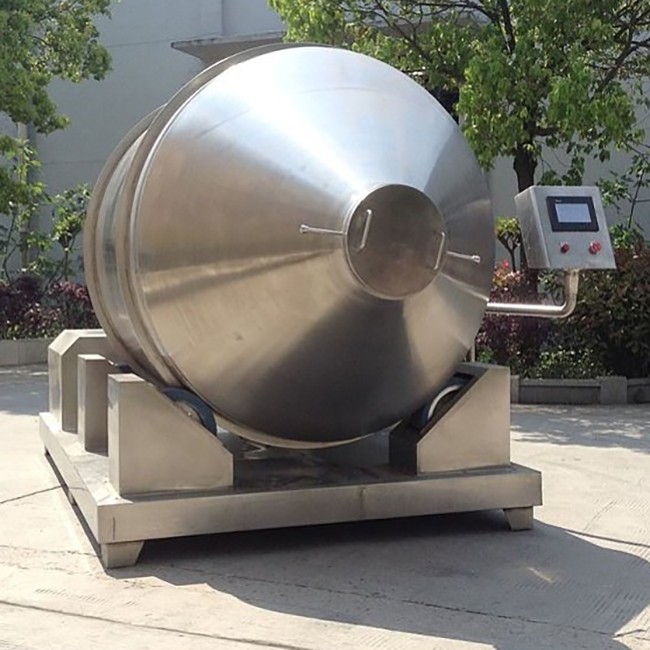

In a laboratory setting, the Laboratory Single Arm Mixer is often used for small - scale mixing. But for larger - scale mixing of explosive materials, the Two Dimensional Mixer is more suitable due to its higher capacity and better explosion - proof design.
Conclusion
In conclusion, a Two Dimensional Mixer used for explosive material mixing must meet a series of strict explosion - proof requirements. From the electrical system design to material selection, sealing, ventilation, and compliance with standards, every aspect is crucial to ensure the safety of the mixing process.
If you are in need of a reliable Two Dimensional Mixer for explosive material mixing, we are here to provide you with high - quality products that meet all the necessary explosion - proof requirements. Our mixers are designed and manufactured with the latest technology and strict quality control to ensure optimal performance and safety. Contact us for more information and to discuss your specific needs. We look forward to the opportunity to work with you on your explosive material mixing projects.
References
- ATEX Directive 2014/34/EU, European Union.
- National Fire Protection Association (NFPA) standards related to explosive materials handling.
- Technical literature on explosion - proof electrical equipment and mixer design.