




How to control the outlet air humidity in a fluidizing dryer?
 Nov 27, 2025|
 As a reputable supplier of Fluidizing Dryer, I understand the critical role that controlling the outlet air humidity plays in the efficiency and effectiveness of fluidizing dryers. In this blog post, I will share some insights and strategies on how to achieve optimal outlet air humidity control in a fluidizing dryer.
Understanding the Importance of Outlet Air Humidity Control
The outlet air humidity in a fluidizing dryer is a key parameter that directly impacts the drying process. Proper humidity control ensures that the material being dried reaches the desired moisture content, maintains its quality, and prevents issues such as over - drying or under - drying.
Over - drying can lead to product degradation, loss of volatile components, and increased energy consumption. On the other hand, under - drying results in products that do not meet the required specifications, which can cause problems in subsequent processing steps or storage.
Factors Affecting Outlet Air Humidity
Inlet Air Conditions
The humidity and temperature of the inlet air have a significant influence on the outlet air humidity. If the inlet air is already humid, it will carry more moisture into the dryer, making it more challenging to achieve the desired low outlet humidity. Additionally, the temperature of the inlet air affects its moisture - holding capacity. Warmer air can hold more moisture than cooler air.
Material Characteristics
The initial moisture content, particle size, and porosity of the material being dried are crucial factors. Materials with high initial moisture content will release more water vapor during the drying process, increasing the outlet air humidity. Smaller particle sizes and higher porosity allow for faster moisture transfer, which can also impact the humidity levels.
Dryer Design and Operating Parameters
The design of the fluidizing dryer, including the air distribution system, residence time of the material in the dryer, and the airflow rate, all affect the outlet air humidity. A well - designed air distribution system ensures uniform drying, while an appropriate residence time allows for sufficient moisture removal. The airflow rate determines how quickly the moisture - laden air is removed from the dryer.
Strategies for Controlling Outlet Air Humidity
Pre - conditioning the Inlet Air
One effective way to control the outlet air humidity is to pre - condition the inlet air. This can be achieved through dehumidification and temperature control. Dehumidifiers can be used to remove excess moisture from the inlet air, reducing the overall moisture load in the dryer. Additionally, heating or cooling the inlet air to an optimal temperature can enhance the drying efficiency. For example, if the material being dried requires a specific temperature range for effective drying, adjusting the inlet air temperature accordingly can help maintain the desired outlet air humidity.
Adjusting the Operating Parameters
- Airflow Rate: Increasing the airflow rate can help remove the moisture - laden air from the dryer more quickly, reducing the outlet air humidity. However, it is important to find the right balance, as too high an airflow rate can cause the material to be carried out of the dryer prematurely or result in uneven drying.
- Residence Time: Adjusting the residence time of the material in the dryer can also impact the outlet air humidity. Longer residence times allow for more moisture to be removed from the material, but this may also increase the energy consumption. By optimizing the residence time based on the material characteristics and drying requirements, we can achieve better humidity control.
Using Moisture Sensors and Feedback Control Systems
Installing moisture sensors at the outlet of the dryer allows for real - time monitoring of the air humidity. These sensors can be connected to a feedback control system that adjusts the operating parameters of the dryer, such as the airflow rate, inlet air temperature, or the amount of material fed into the dryer. For example, if the outlet air humidity is higher than the desired level, the control system can increase the airflow rate or adjust the inlet air temperature to enhance the drying process.
Combining with Other Drying Technologies
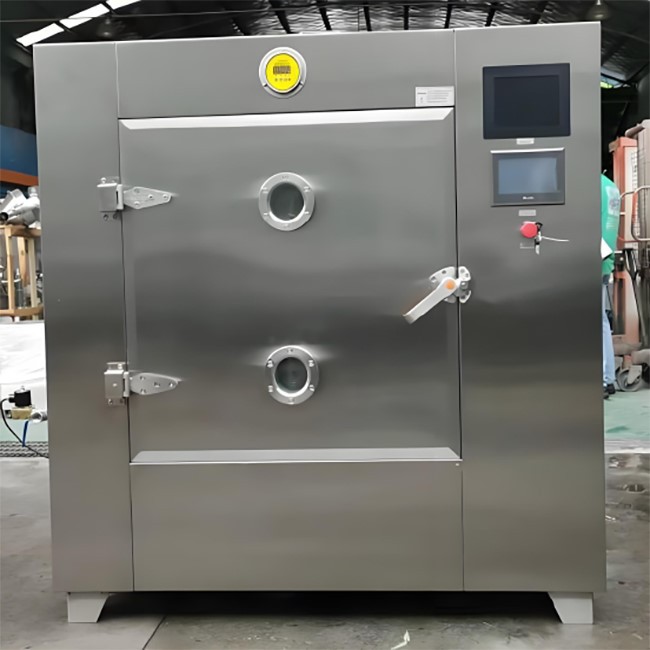
In some cases, combining the fluidizing dryer with other drying technologies can improve the outlet air humidity control. For instance, using a Double Cone Rotary Vacuum Dryer before or after the fluidizing dryer can help remove a significant amount of moisture from the material. The vacuum environment in the double - cone rotary vacuum dryer allows for lower - temperature drying, which can be beneficial for heat - sensitive materials. Another option is to use a Box Type Microwave Vacuum Dryer, which uses microwave energy to heat the material from the inside out, accelerating the moisture removal process.
Case Studies
Let's consider a case where a food processing company was using a fluidizing dryer to dry a granular food product. Initially, they were experiencing issues with inconsistent outlet air humidity, which led to some batches of the product being over - dried and others being under - dried.
After conducting a detailed analysis, we recommended pre - conditioning the inlet air using a dehumidifier and adjusting the airflow rate and residence time. We also installed moisture sensors at the outlet of the dryer and a feedback control system. As a result, the outlet air humidity became more stable, and the quality of the dried product improved significantly. The company was able to reduce energy consumption by 15% and increase the overall production efficiency by 20%.
Conclusion
Controlling the outlet air humidity in a fluidizing dryer is essential for achieving high - quality drying results and optimizing the energy consumption. By understanding the factors that affect the outlet air humidity and implementing appropriate strategies such as pre - conditioning the inlet air, adjusting the operating parameters, using moisture sensors and feedback control systems, and combining with other drying technologies, we can effectively manage the humidity levels.
If you are facing challenges with outlet air humidity control in your fluidizing dryer or are looking for a reliable fluidizing dryer solution, I encourage you to reach out for a detailed consultation. Our team of experts is ready to provide customized solutions based on your specific requirements and help you achieve the best drying performance.

References
- Mujumdar, A. S. (Ed.). (2014). Handbook of industrial drying. CRC press.
- Keey, R. B. (1992). Principles of industrial drying. Pergamon Press.
- Masters, K. (1991). Spray drying handbook. John Wiley & Sons.