




How to achieve good mixing of materials with different particle sizes in a trough mixer?
 Nov 03, 2025|
 Achieving good mixing of materials with different particle sizes in a trough mixer is a common challenge in many industries, including pharmaceuticals, food processing, and chemical manufacturing. As a trough mixer supplier, I've seen firsthand the importance of getting this right. In this blog post, I'll share some tips and tricks on how to achieve optimal mixing results.
Understanding the Basics of Trough Mixers
First off, let's talk a bit about trough mixers. A trough mixer, which you can learn more about here, consists of a U-shaped trough and a rotating agitator. The agitator moves the materials in the trough, causing them to mix. But when you're dealing with materials of different particle sizes, things can get a bit tricky.
Factors Affecting Mixing
There are several factors that can affect how well materials with different particle sizes mix in a trough mixer. One of the most important is the particle size distribution itself. If you have a wide range of particle sizes, it can be more difficult to achieve a homogeneous mixture. For example, larger particles tend to settle to the bottom of the trough, while smaller particles may float to the top.
Another factor is the density of the materials. Materials with different densities will also behave differently during mixing. Heavier materials may sink, while lighter ones may rise. This can lead to segregation and an uneven mixture.
The shape of the particles can also play a role. Irregularly shaped particles may not flow as easily as spherical ones, which can affect the mixing process.
Tips for Achieving Good Mixing
Now that we understand the factors at play, let's look at some tips for achieving good mixing of materials with different particle sizes in a trough mixer.
1. Pre - blending
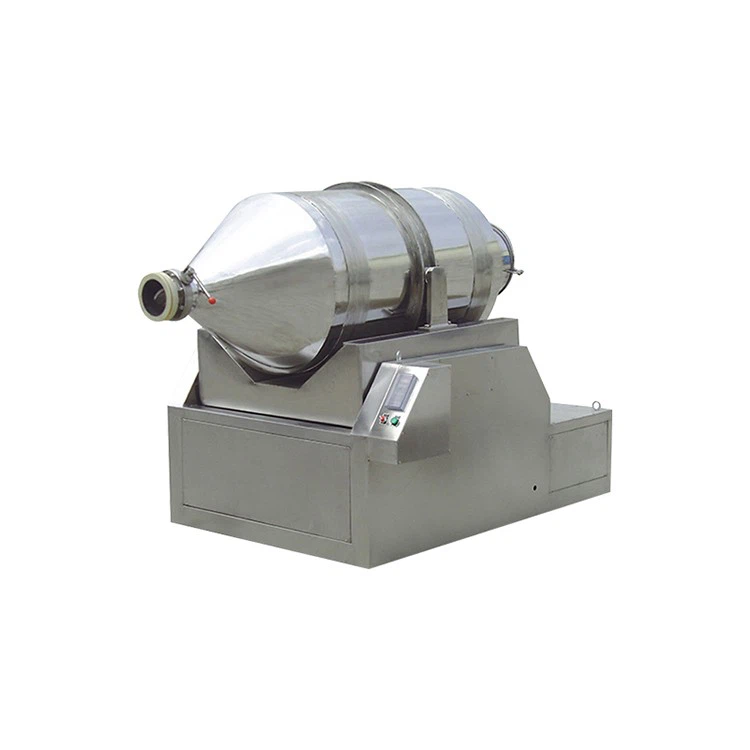
One effective strategy is to pre - blend the materials before putting them into the trough mixer. This can help to reduce the initial differences in particle size and density. You can use a simpler mixer, like a Two Dimensional Mixer, for pre - blending. This will create a more uniform starting point for the trough mixer.
2. Adjusting the Agitator Speed
The speed of the agitator in the trough mixer is crucial. If the speed is too slow, the materials may not mix thoroughly. On the other hand, if it's too fast, it can cause the materials to become airborne or create a vortex that leads to poor mixing. You need to find the optimal speed for your specific materials. This may require some trial and error, but it's worth the effort.
3. Using Baffles
Baffles are structures inside the trough that can help to disrupt the flow of the materials and improve mixing. They can prevent the formation of dead zones where the materials don't move much. By installing baffles in the trough mixer, you can ensure that all the materials are constantly being agitated and mixed.
4. Adding Liquids
In some cases, adding a small amount of liquid can help to improve the mixing of materials with different particle sizes. The liquid can act as a binder, helping the smaller particles to stick to the larger ones. However, you need to be careful not to add too much liquid, as it can cause the mixture to become too wet and difficult to handle.
5. Mixing Time
The length of time you mix the materials is also important. You need to mix them long enough to achieve a homogeneous mixture, but not so long that it causes over - mixing or degradation of the materials. Start with a conservative mixing time and then test the mixture to see if it meets your requirements. You may need to adjust the time based on the results.

Monitoring and Quality Control
Once you've set up the mixing process, it's important to monitor it regularly. You can take samples of the mixture at different intervals and analyze them to check for uniformity. There are various methods for analyzing the mixture, such as sieving to check the particle size distribution or using chemical analysis to check the composition.
If you find that the mixture is not up to standard, you may need to make some adjustments to the mixing process. This could involve changing the agitator speed, adding more baffles, or adjusting the mixing time.
Case Studies
Let's look at a couple of case studies to see how these tips work in real - world scenarios.
In a pharmaceutical company, they were trying to mix a powder with different particle sizes for a tablet formulation. They started by pre - blending the materials using a two - dimensional mixer. Then, they adjusted the agitator speed in the trough mixer based on some initial tests. They also installed baffles in the trough to improve the mixing. After a few trials, they were able to achieve a homogeneous mixture that met their quality standards.
In a food processing plant, they were mixing different grains with varying particle sizes. They added a small amount of oil as a liquid binder to help the smaller grains stick to the larger ones. By carefully controlling the mixing time and agitator speed, they were able to produce a well - mixed product that was ready for further processing.
Conclusion
Achieving good mixing of materials with different particle sizes in a trough mixer is definitely a challenge, but it's not impossible. By understanding the factors that affect mixing, using the right strategies, and implementing proper monitoring and quality control, you can achieve excellent results.
If you're in the market for a trough mixer or need more advice on mixing materials, don't hesitate to reach out. We're here to help you find the best solution for your specific needs. Whether you're a small laboratory looking for a Laboratory Three - dimensional Mixer or a large - scale manufacturing plant in need of a high - capacity trough mixer, we've got you covered. Contact us today to start a discussion about your mixing requirements.
References
- Perry, R. H., & Green, D. W. (1997). Perry's Chemical Engineers' Handbook. McGraw - Hill.
- Harnby, N., Edwards, M. F., & Nienow, A. W. (1992). Mixing in the Process Industries. Butterworth - Heinemann.