




Can a Two Dimensional Mixer be used for mixing materials with different densities?
 Oct 13, 2025|
 Can a Two Dimensional Mixer be used for mixing materials with different densities?
As a supplier of Two Dimensional Mixers, I often get asked whether our product can effectively mix materials with different densities. This is a crucial question in various industries such as pharmaceuticals, food processing, and chemical manufacturing, where materials of varying densities need to be uniformly blended. In this blog post, I will delve into the capabilities of a Two Dimensional Mixer in handling materials with different densities and provide insights into its performance and limitations.
How a Two Dimensional Mixer Works
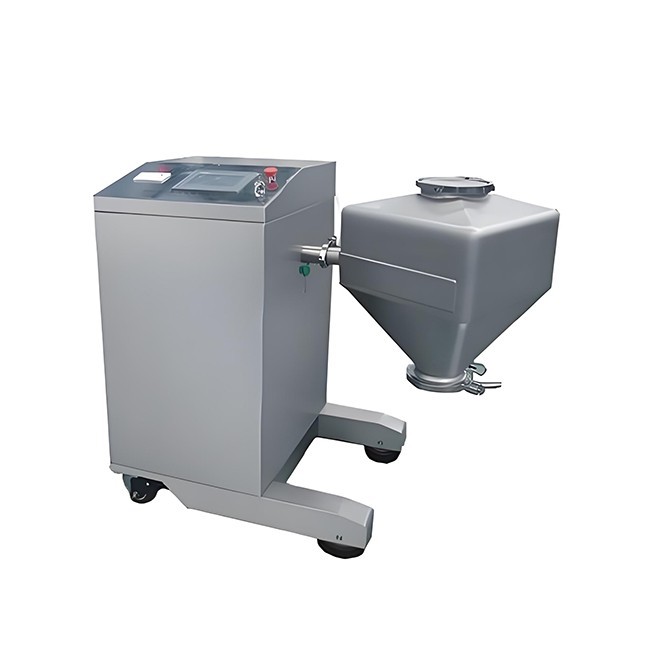
Before we discuss its ability to mix materials of different densities, let's understand how a Two Dimensional Mixer operates. A Two Dimensional Mixer, as the name suggests, moves the mixing container in two directions - usually a combination of a rotating motion and a swinging motion. This dual - dimensional movement creates a complex flow pattern inside the mixing chamber, which helps in achieving a homogeneous mixture.
The rotating motion causes the materials to tumble within the container, while the swinging motion adds an additional force that distributes the materials more evenly. This combination of movements is designed to break up agglomerates and ensure that all particles are thoroughly mixed.
Mixing Materials with Different Densities
When it comes to mixing materials with different densities, the performance of a Two Dimensional Mixer depends on several factors.
Density Difference
The degree of density difference between the materials plays a significant role. In cases where the density difference is relatively small, a Two Dimensional Mixer can achieve a satisfactory mix. For example, if you are mixing two powders where one has a density of 1.2 g/cm³ and the other has a density of 1.4 g/cm³, the mixer's dual - dimensional movement can overcome the minor gravitational separation forces and distribute the particles evenly.
However, when the density difference is large, say between a light powder with a density of 0.2 g/cm³ and a heavy granular material with a density of 2.0 g/cm³, the mixer may face challenges. The heavier particles tend to settle at the bottom due to gravity, and the mixer's movement may not be sufficient to continuously re - distribute them throughout the mixture.
Particle Size
Particle size also affects the mixing process. If the materials have similar particle sizes, it is easier for the Two Dimensional Mixer to mix them, even if they have different densities. Smaller particles have a larger surface area - to - volume ratio, which allows them to interact more easily during the mixing process. On the other hand, if the particle sizes are significantly different, the larger particles may act as obstacles, preventing the smaller particles from being evenly distributed.
Mixing Time
The length of the mixing time is another important factor. Longer mixing times can sometimes compensate for the challenges posed by different densities. By allowing the mixer to operate for an extended period, the materials have more opportunities to interact and blend. However, there is a limit to this approach. Prolonged mixing can lead to over - mixing, which may cause degradation of the materials or the formation of new agglomerates.
Advantages of Using a Two Dimensional Mixer for Density - Diverse Materials
Despite the challenges, there are several advantages to using a Two Dimensional Mixer for mixing materials with different densities.
Gentle Mixing
Two Dimensional Mixers offer a relatively gentle mixing action compared to some other types of mixers. This is beneficial for materials that are sensitive to high - shear forces. For example, in the pharmaceutical industry, where many active ingredients are delicate, a gentle mixing process can prevent damage to the particles and maintain the integrity of the product.
Versatility
These mixers are versatile and can be used for a wide range of materials. They can handle both dry powders and wet granulates, making them suitable for different stages of the manufacturing process. This versatility is especially useful in industries where multiple types of materials need to be mixed.
Comparing with Other Mixers
To better understand the capabilities of a Two Dimensional Mixer, it is useful to compare it with other types of mixers commonly used for mixing materials with different densities.
Square Cone Mixer
A Square Cone Mixer is another popular option for mixing materials. It operates on a principle similar to the Two Dimensional Mixer, with a rotating and tumbling motion. However, the square cone shape of the mixing container provides a more intense mixing action in some cases. The Square Cone Mixer may be more effective for materials with larger density differences, as the shape of the container helps to break up the segregation of heavy and light particles more efficiently.
Vacuum Feeder Machine
A Vacuum Feeder Machine is not a mixer per se, but it can be used in conjunction with a Two Dimensional Mixer. It is used to transfer materials into the mixer, and its ability to handle materials of different densities can be an advantage. By using a Vacuum Feeder Machine, you can ensure that the materials are evenly fed into the mixer, which can improve the overall mixing process.
Laboratory Hopper Mixer
Laboratory Hopper Mixers are often used for small - scale mixing operations. They are designed to be compact and easy to use. While they can mix materials with different densities, their capacity is limited compared to a Two Dimensional Mixer. For larger - scale production, a Two Dimensional Mixer is usually a more suitable choice.

Improving the Mixing Performance
If you are using a Two Dimensional Mixer to mix materials with different densities and are facing challenges, there are several steps you can take to improve the mixing performance.
Pre - Blending
Pre - blending the materials before adding them to the Two Dimensional Mixer can help. This can be done manually or using a simple mixing device. By pre - blending, you can reduce the initial density segregation and make it easier for the mixer to achieve a homogeneous mixture.
Adjusting Mixing Parameters
You can also adjust the mixing parameters such as the speed of rotation and the amplitude of the swinging motion. Experimenting with different settings can help you find the optimal combination for your specific materials.
Conclusion
In conclusion, a Two Dimensional Mixer can be used for mixing materials with different densities, but its effectiveness depends on various factors such as the density difference, particle size, and mixing time. While it has some limitations, especially when dealing with large density differences, it also offers advantages such as gentle mixing and versatility.
If you are considering using a Two Dimensional Mixer for your mixing needs, I encourage you to contact us for more information. Our team of experts can provide you with detailed advice on whether a Two Dimensional Mixer is the right choice for your specific materials and production requirements. We can also assist you in optimizing the mixing process to ensure the best possible results.
References
- Perry, R. H., & Green, D. W. (1997). Perry's Chemical Engineers' Handbook. McGraw - Hill.
- Rhodes, M. J. (2008). Introduction to Particle Technology. Wiley.